
Zakat on Shares and Investments: How It Works for Funds, ISAs and Pensions
Nov 04, 2026
The short answer: zakat on shares is commonly calculated in one of two ways, depending on why the shares are held. Shares bought to sell in the short term are usually treated like trade goods, so zakat of 2.5% is paid on their full market value. Shares and funds held for the long term are usually assessed only on the share of the company's assets that are themselves zakatable (cash, receivables and stock), and because that figure is hard to find, many UK investors use a proxy of 25% to 30% of market value. Pensions, ISAs and Junior ISAs follow the same principles, with a few extra questions about ownership and access.
With Ramadan 2027 expected to begin around 8 February 2027 (subject to moon sighting), many UK Muslims are starting to work out their zakat. This guide explains the mainstream approaches, where scholars differ, and how the numbers work.
A quick refresher: when is zakat due at all?
Zakat is an annual obligation of 2.5% on zakatable wealth that has been held for one lunar year (the hawl) and is above the nisab threshold. The usual points are:
- Nisab is the minimum amount of wealth before zakat applies. It is based on the value of either gold (about 85 to 87.48 grams, depending on the opinion followed) or silver (about 595 to 612.36 grams). Because silver is far cheaper, the silver nisab is much lower. At the time of writing, the National Zakat Foundation (NZF) live figures put the silver nisab at roughly £650 and the gold nisab at roughly £7,400. These change daily with metal prices.
- The zakat date is the anniversary of the day wealth first reached nisab. Many people pay in Ramadan, but the obligation follows the zakat anniversary.
- The rate is 2.5% per lunar year, or 2.577% for those who calculate on a calendar year.
Investments are added to cash, gold, silver and money owed to you to see whether the total is above nisab. The question is how much of an investment counts.
The key distinction: trading shares or long-term holdings
Classical scholars treated wealth held for resale (trade goods, or 'urud al-tijarah) differently from wealth held to produce income, and modern guidance applies the same idea to shares.
Shares bought to sell
Shares bought with the intention of selling them for a profit, as in active trading, are commonly treated as trade goods. Zakat is then calculated on the full market value on the zakat date. This is the approach set out in AAOIFI Shariah Standard No. 35 on Zakat and followed by NZF and most UK zakat organisations.
Shares and funds held for the long term
If shares are held for dividends and long-term growth rather than to sell, the mainstream view is that zakat is due on your proportionate share of the company's zakatable assets, not on the share price. Zakatable assets here mean things like cash, receivables and inventory held by the company. Buildings, machinery, brands and other fixed assets are not zakatable.
In practice, almost nobody can read the balance sheet of every company in a global index fund, so AAOIFI Standard 35 allows an estimate where the exact zakatable assets per share cannot be known. This is where proxies come in.
The 25% and 30% proxies explained
Two proxies are widely used:
| Source | Proxy for long-term holdings | Zakat as % of market value | Basis |
|---|---|---|---|
| National Zakat Foundation (UK) | 25% of market value | 0.625% | NZF analysis of FTSE 100 balance sheets with scholars and accountants |
| Zoya (US based app) | 30% of market value | 0.75% | Method from Sheikh Joe Bradford's Simple Zakat Guide |
| Trading intention (all sources) | 100% of market value | 2.5% | Shares treated as trade goods |
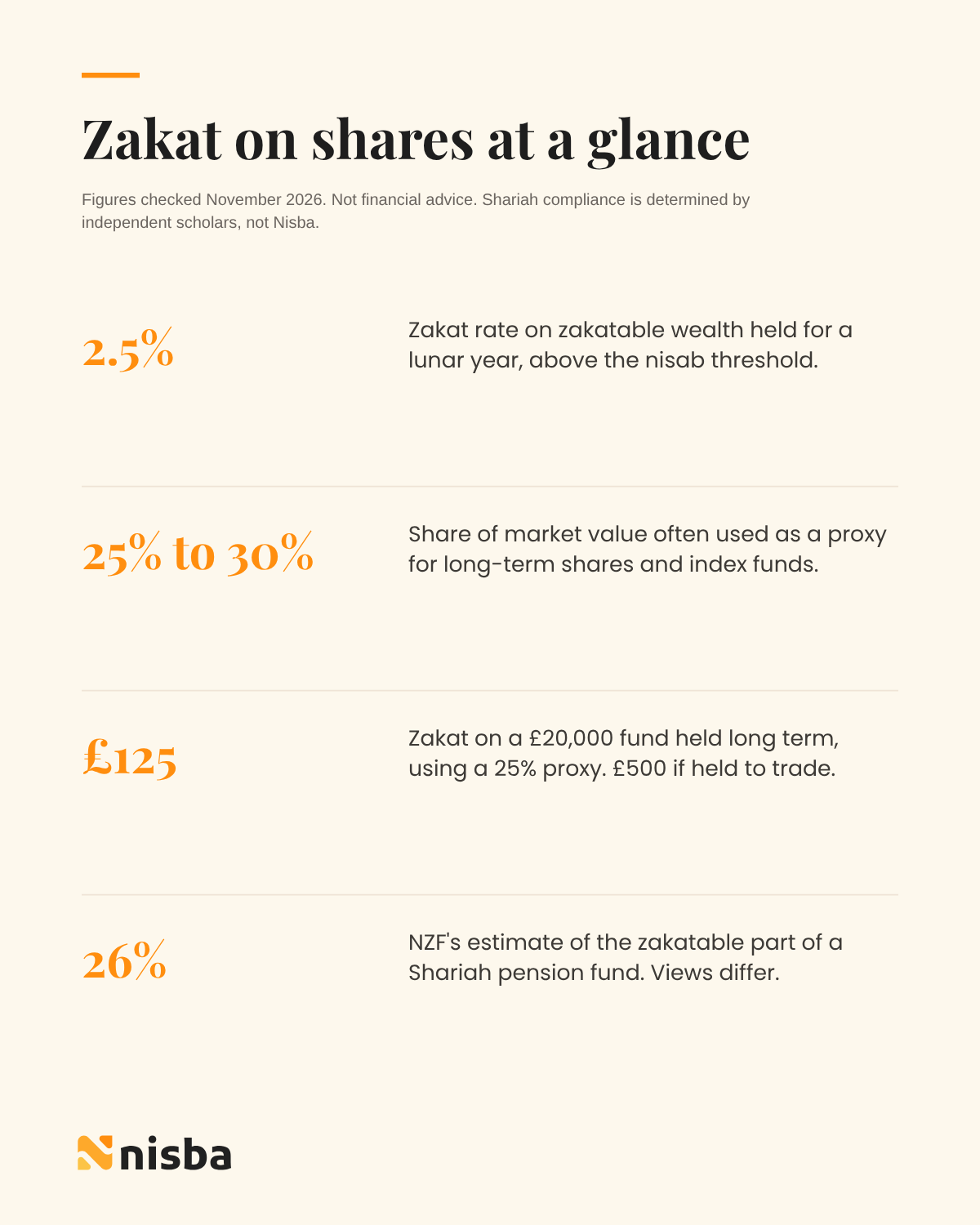
NZF's figure comes from a study of FTSE 100 companies, about two thirds of which had zakatable net assets below 25% of their value, applying the fiqh principle that "the majority is given the ruling of the whole". NZF says the proxy is reviewed periodically (an earlier 40% figure is no longer used) and does not apply to private limited companies.
Some investors prefer the higher 30% figure, or the full market value, out of caution. Others calculate the actual figure from published balance sheet data. These are all recognised approaches, and the choice is usually guided by the scholar or organisation a person follows. In each case the calculation uses the value on the zakat date.
Worked examples
The figures below are illustrations of how each method works, not a calculation for any individual.
| Holding | Value on zakat date | Method | Zakatable amount | Zakat at 2.5% |
|---|---|---|---|---|
| Shariah index fund, held long term | £20,000 | 25% proxy (NZF) | £5,000 | £125 |
| Same fund | £20,000 | 30% proxy (Zoya) | £6,000 | £150 |
| Shares bought to trade | £20,000 | Full value | £20,000 | £500 |
| Cash in a Cash ISA or savings account | £5,000 | Full value | £5,000 | £125 |
| Workplace pension in a Shariah fund | £40,000 | 26% (NZF pension table) | £10,400 | £260 |
On the same £20,000 fund, the result ranges from £125 to £500, which is why the intention behind each holding matters.
Index funds, ETFs and managed funds
Funds such as the HSBC Islamic Global Equity Index Fund, Shariah ETFs and robo-adviser portfolios like Wahed Invest are usually held for the long term, so the proxy method is the one most commonly applied. NZF applies its 25% approach to managed funds and unit trusts in the same way as to shares. A few details come up often:
- Funds that hold sukuk or cash. A multi-asset portfolio with sukuk, gold or cash has a higher proportion of zakatable assets than a pure equity fund. Some investors split the portfolio by asset type and apply a different percentage to each part.
- Gold ETFs. Physically backed gold funds are often treated as gold, and so zakatable on their full value, though views differ.
- Dividends. Dividends still held as cash on the zakat date are counted as cash.
Zakat on ISAs
An ISA is a tax wrapper, so the zakat treatment follows what is inside it. The halal ISA guide covers the different ISA types in detail.
- Cash ISA (including Islamic Cash ISAs): treated as cash, so zakat is commonly due on the full balance.
- Stocks and Shares ISA: the same rules as shares held outside an ISA. NZF notes that if someone is about to cash in their ISA, the whole market value is commonly treated as zakatable.
- Lifetime ISA: a withdrawal charge applies if money is taken out other than for a first home, after 60 or in terminal illness. Some scholars deduct the amount that would be lost to the charge, others treat it like any other ISA.
Junior ISAs and children's investments
A Junior ISA legally belongs to the child. The Hanafi school holds that zakat is not due on the wealth of a minor, while the Maliki, Shafi'i and Hanbali schools hold that it is, with the guardian paying it from the child's wealth.
Zakat on pensions
Pensions raise the most debate, because the money is often locked away until at least age 55 (rising to 57 from April 2028) and much of it may have come from an employer. The are pensions halal article explains the different scheme types.
Defined contribution pensions
These include workplace schemes such as Nest, personal pensions and SIPPs, where a pot of money is invested in your name. The main views are:
- Zakat is due each year on the zakatable proportion of the pot. NZF advocates this view, based on the Al-Qalam Shariah panel, reasoning that the holder has effectively appointed an investment manager, so lack of access does not remove the obligation. NZF publishes estimated zakatable proportions by fund type: about 26% for Shariah funds, 27% for equity funds, 50% for mixed asset, 15% for direct property and 100% for bonds, gilts and fixed interest. NZF also allows the zakat on pension assets to be deferred and paid when the pension is accessed.
- Zakat is due only on employee contributions, payable once received. Some scholars, including an answer published by SeekersGuidance in December 2025, take the view that no zakat is due on what the employer contributed and that zakat on the rest is payable on receipt.
- No zakat until the money is accessible. Others hold that because the holder cannot access the funds, full ownership is incomplete, so zakat begins only once the pension can be drawn.
NZF's own pages are not fully consistent on details: its pension table gives 27% for equity funds while its written answer suggests 25%.
Defined benefit pensions
Final salary and career average schemes, including the NHS, teachers' and civil service pensions, do not hold a pot of money in the member's name. NZF and SeekersGuidance both hold that zakat is not due on defined benefit schemes; payments become part of normal wealth once received. NZF also notes there is no zakat on National Insurance contributions.
Zakat is not the same as purification
Purification means giving away the small portion of income that came from non-compliant activity, such as interest a company earns on its cash. It does not count towards zakat. Many Shariah funds purify at fund level (see what happens when a halal stock turns non compliant), but zakat remains the investor's own responsibility.
Deductions commonly allowed
Most methods allow debts due now (a bill or a payment currently owed) to be deducted before working out 2.5%. For long-term debts such as a home purchase plan, many scholars allow only the instalment currently due.
Frequently asked questions
Do you pay zakat on shares?
Yes, in the mainstream view. The amount depends on intention: full market value for shares bought to trade, or the zakatable proportion of company assets (often estimated at 25% to 30% of market value) for long-term holdings.
How do you calculate zakat on shares?
For long-term holdings, a common UK method is 2.5% of 25% of the market value on the zakat date, which is 0.625% of the holding. For trading shares, the usual approach is 2.5% of full market value.
Do you pay zakat on a Stocks and Shares ISA?
Yes. The ISA wrapper does not change the zakat treatment. The investments inside are treated in the same way as investments held outside an ISA.
Is zakat due on a pension?
Views differ. NZF holds that zakat is due on the zakatable proportion of a defined contribution pension, with the option to defer payment until the pension is accessed. Other scholars hold that zakat is due only when the money is received. Defined benefit schemes are commonly regarded as not zakatable until payments begin.
Do you pay zakat on the full value of an index fund?
Not usually, if it is held for the long term. Most guidance applies a proxy instead, though some investors pay on the full value out of caution.
Is zakat due on a Junior ISA?
It depends on the school followed. The Hanafi school holds that zakat is not due on a child's wealth, while the other three main schools hold that it is, paid by the guardian from the child's wealth.
Learning the framework behind halal investing
The Nisba Academy is a one-month course built around a six-step framework covering halal investing from the basics: how screening works, how funds and platforms compare, how pensions and ISAs fit together, and how to plan around obligations like zakat. It comes with a money back guarantee. The guide to halal investing for beginners covers the basics, and Nisba's zakat calculator can help bring the numbers together.
This article is for education only and is not financial advice or a personal recommendation. Nisba does not make religious rulings: whether an investment is Shariah compliant is determined by the independent scholars who approve it. Investments can fall as well as rise and you may get back less than you put in. Tax rules can change and depend on your circumstances.
Learn more about Halal Investing
Stay up to date with halal investing
Join our mailing list for the latest insights, updates, and opportunities from Nisba.
We respect your privacy, no spam, ever.