
HSBC Islamic Global Equity Index Fund Review: Charges, Holdings, Performance and Which Version You Hold
Oct 28, 2026
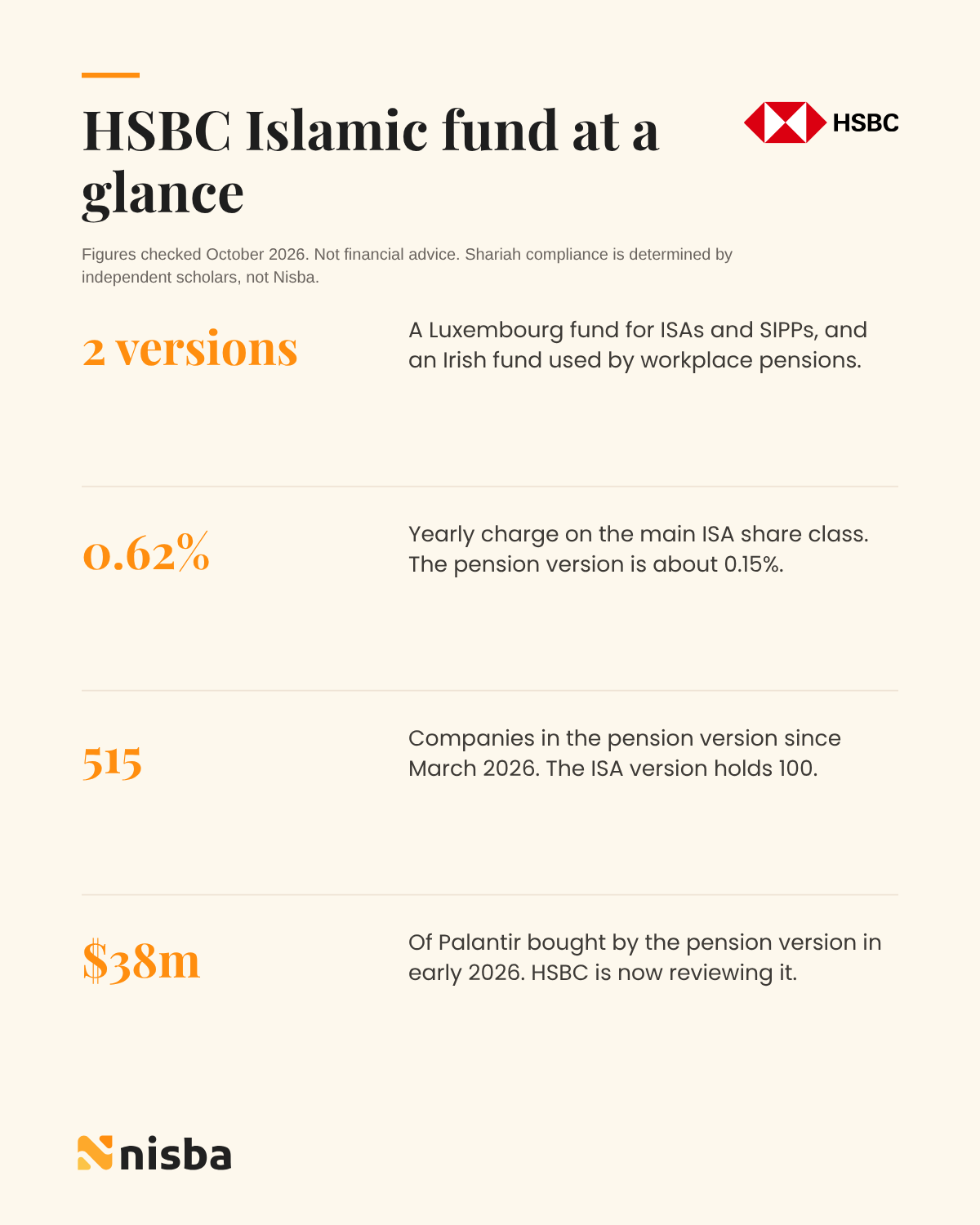
The short answer: the HSBC Islamic Global Equity Index Fund is a passive fund that tracks an index of large Shariah-screened companies around the world. It is the most widely held Islamic fund in the UK, mainly because it sits inside most workplace pension Shariah options, including the Nest Sharia Fund. There are two separate versions: a Luxembourg fund sold on ISA and SIPP platforms, which tracks about 100 companies and charges 0.62% a year for the main retail share class, and an Irish fund used by pension schemes, which has tracked a much broader index of over 500 companies since March 2026. Both are heavily weighted to large US technology companies. The companies in both indices are screened by Ratings Intelligence, the Shariah screening firm used by S&P Dow Jones Indices, and HSBC's Shariah committee certifies the fund against AAOIFI standards, but in October 2026 HSBC announced a review of the pension version's Palantir holding after concerns from Nest and The People's Pension.
Key facts at a glance
The two versions share a name and a Shariah committee but are different funds, with different indices, holdings and charges. Figures are from HSBC factsheets dated 30 September 2026.
| Retail version (ISA and SIPP platforms) | Pension version (workplace schemes) | |
|---|---|---|
| Legal name | HSBC Islamic Funds: HSBC Islamic Global Equity Index Fund | HSBC UCITS Common Contractual Fund: Islamic Global Equity Index Fund |
| Domicile | Luxembourg | Ireland |
| Index tracked | Dow Jones Islamic Market Titans 100 | S&P Global 1200 Shariah Select (since 23 March 2026) |
| Number of holdings | 100 | 515 |
| Fund size | About USD 3.2 billion | About USD 8.5 billion |
| Ongoing charge | 0.62% (BC GBP class), 0.49% (IC class) | 0.15% estimated (A3C GBP class), before pension provider charges |
| US weighting | About 79% | About 77% |
| Technology weighting | About 59% | About 55% |
| Typical route in | Stocks and Shares ISA, Lifetime ISA, Junior ISA, SIPP, general account | Workplace pension fund options, often under the provider's own fund name |
Which version do you hold?
- Through a workplace pension: most UK workplace Shariah fund options use the Irish pension version, either directly or as part of a blend. Providers usually give it their own label, such as "Aviva Pension HSBC Islamic Global Equity Index". The Nest Sharia Fund holds about 70% in this fund and about 30% in sukuk, as covered in our Nest Sharia Fund guide.
- Through an ISA or SIPP you chose yourself: platforms such as Hargreaves Lansdown, AJ Bell and Fidelity list the Luxembourg retail version, most commonly the BC GBP accumulation class (ISIN LU2092165666). AJ Bell also lists the cheaper IC class (ISIN LU1569385302).
The ISIN or fund name on a pension statement or platform page confirms which one is held. This matters, because the two versions now hold different lists of companies.
What does the fund hold?
Both versions start from a large global index, remove companies that fail Shariah screens, and hold the rest in proportion to their size. Because banks, insurers, alcohol, gambling and many highly indebted businesses are screened out, Islamic indices tend to lean heavily towards large technology companies, which often carry little debt.
Retail version (Titans 100), top holdings at 30 September 2026: Apple 8.2%, Microsoft 8.1%, Alphabet 8.0%, NVIDIA 7.9% and Amazon 5.3%. The top ten make up just over half of the fund.
Pension version (S&P Global 1200 Shariah Select), top holdings at 30 September 2026: NVIDIA 8.4%, Apple 7.4%, Microsoft 5.8%, Alphabet 5.6%, Amazon 3.7%, Taiwan Semiconductor 2.9%, Broadcom 2.6%, Meta 2.4%, Micron 1.8% and Tesla 1.5%. Its sector split was technology 54.6%, industrials 12.2%, health care 10.0% and consumer discretionary 9.8%.
The move to the broader S&P index in March 2026 spread the pension version across more companies and countries, and also brought several defence and military-linked companies into it (see below).
Performance
The figures below are HSBC's, after fund charges, to 30 September 2026. Past performance is not a guide to the future.
| Period | Retail BC GBP | Retail benchmark | Pension A3C GBP | Pension benchmark |
|---|---|---|---|---|
| 1 year | 24.2% | 25.3% | 23.4% | 23.4% |
| 3 years (a year) | 21.9% | 22.8% | 22.1% | 22.1% |
| 5 years (a year) | 15.1% | 15.9% | n/a | n/a |
| Since launch of the share class (a year) | 15.7% (Oct 2020) | 16.5% | 21.0% (Nov 2022) | 21.1% |
| 12 months to Sept 2025 | 15.7% | 16.3% | 16.4% | 16.3% |
| 12 months to Sept 2024 | 26.1% | 27.0% | 26.9% | 27.0% |
| 12 months to Sept 2022 | minus 4.1% | minus 3.6% | n/a | n/a |
The pension version's A3C share class launched in November 2022, so it now has a full three-year record. For most of that period it tracked the same Titans 100 index as the retail version, which is why the two sets of returns are close. Only the last six months reflect the broader S&P index.
Two other points are commonly noted about these numbers:
- Tracking gap. The retail BC class has trailed its index by roughly 0.8 to 1.1 percentage points a year, which is larger than its 0.62% ongoing charge alone. The pension version, with a much lower charge, has tracked its index almost exactly. The pension figures are before any charges the pension provider adds.
- Concentration risk. Strong returns from a handful of US technology companies drove most of the growth. The same concentration produced the fall in the year to September 2022, and HSBC reports a three-year volatility of about 14% for the retail class.
Charges
The BC GBP accumulation class sold on most platforms (and its BD GBP income twin) has an ongoing charge of 0.62% a year. AJ Bell also offers the IC class at 0.49%. The pension version's A3C class has an estimated charge of 0.15%. Platform or pension provider charges are added on top. For investors comparing the cost of holding a Shariah fund in a pension, our article on the cheapest halal pension in the UK sets out the main options.
How the fund is screened, and who approves it
The fund does not choose stocks itself, and neither, in practice, does HSBC. There are three layers:
- The Shariah screening firm: Ratings Intelligence. Both indices the fund has tracked belong to S&P Dow Jones Indices, which owns the Dow Jones Islamic Market and S&P Shariah index families. Its methodology documents for both families state that it "has contracted with Ratings Intelligence Partners (RI) to provide the Shariah screens". RI is a London and Kuwait based consultancy whose researchers work with a Shariah supervisory board of scholars. In effect, RI's screening decides which companies are eligible for the index, and so which companies end up in the fund.
- The index provider: S&P Dow Jones Indices. It builds and maintains the index from the companies that pass RI's screens, and sets rules such as how many companies are included and how they are weighted. The switch from Titans 100 to the S&P Global 1200 Shariah Select was a change of index, not a change of screening firm.
- The fund manager: HSBC. HSBC chooses which index to track and then copies it. Its own Shariah committee (Dr Mohamed Ali Elgari, Sheikh Nizam Yaquby and Dr Aznan Hasan, according to its annual Shariah compliance report) monitors the fund and issues an annual certificate stating that it complies with the Shariah standards of AAOIFI (the Accounting and Auditing Organization for Islamic Financial Institutions).
The screens themselves follow the mainstream model:
- Business activity screens remove companies whose main business is in areas such as conventional finance, alcohol, pork, gambling, tobacco and adult entertainment. Under the S&P Shariah methodology, non-permissible income plus interest income must also be below 5% of a company's total income.
- Financial ratio screens require interest-bearing debt, and cash plus interest-bearing securities, each to be below 30% of the company's average market value (a 24-month average for the Dow Jones Islamic indices and a 36-month average for the S&P Shariah indices).
- Purification gives away to charity the small share of income that comes from non-permitted activities, using ratios supplied by the index provider. The Luxembourg fund's half-year report to 30 June 2026 records a purification amount of USD 424,215 for 2025.
On this basis, the fund is commonly regarded as a Shariah-compliant equity option by mainstream screening standards. Views do differ. Some scholars and investors prefer stricter ratio limits than the major index providers use, and a growing number of Muslim investors also apply ethical or BDS (Boycott, Divestment and Sanctions) screens, which standard Shariah methodologies do not include. Nisba explains how these screens interact in what makes a company like Caterpillar both halal and haram to invest in at the same time.
The Palantir review and defence holdings
On 13 October 2026, the outlet Hyphen reported that the HSBC Islamic Global Equity Index Fund had bought about USD 38 million of Palantir shares in the first half of 2026, after the switch to the S&P index. Palantir signed a strategic partnership with Israel's Ministry of Defense in January 2024. Middle East Eye later reported that the fund bought over USD 100 million of shares in five companies linked to the Israeli military over the same period, including about USD 35.7 million of RTX (formerly Raytheon).
On 20 October 2026, HSBC said it would review the matter "carefully, in partnership with independent expert advisors" and communicate any necessary actions. Nest and The People's Pension have both raised concerns with HSBC. At the time of writing, no outcome had been announced.
These reports relate to the pension version. The Luxembourg retail version's half-year report lists no Palantir, RTX, Lockheed Martin or BAE Systems holdings at 30 June 2026, which is consistent with it still tracking the narrower Titans 100 index. Nisba's earlier article, HSBC funds complicit in genocide?, covers the wider debate, and what happens when your halal stock turns non compliant explains how index changes flow through to funds.
The three layers above explain why this is not only a question for HSBC. Changing what the fund holds would normally mean Ratings Intelligence or S&P changing the index, or HSBC choosing a different index or adding its own exclusions.
Frequently asked questions
Is the HSBC Islamic Global Equity Index Fund halal?
Its index is screened by Ratings Intelligence for S&P Dow Jones Indices, using mainstream business activity and financial ratio screens, and HSBC's Shariah committee certifies the fund against AAOIFI standards. It is commonly regarded as Shariah compliant on that basis. Some investors raise separate ethical and BDS concerns about individual holdings, particularly in the pension version.
What index does the HSBC Islamic Global Equity Index Fund track?
The Luxembourg retail version tracks the Dow Jones Islamic Market Titans 100 Index. The Irish pension version tracked the same index until 23 March 2026 and now tracks the S&P Global 1200 Shariah Select Index.
What are the HSBC Islamic Global Equity Index Fund charges?
The ongoing charge is 0.62% a year for the BC GBP class sold on most platforms, 0.49% for the IC class and an estimated 0.15% for the pension version, before platform or pension provider charges.
Does the HSBC Islamic fund hold Palantir?
The pension version bought about USD 38 million of Palantir shares in the first half of 2026, according to Hyphen. HSBC announced a review in October 2026. The retail version did not list Palantir at 30 June 2026.
Can I hold the HSBC Islamic Global Equity Index Fund in an ISA?
Yes. The retail version is ISA eligible and is listed on platforms including Hargreaves Lansdown, AJ Bell and Fidelity for Stocks and Shares ISAs, Lifetime ISAs and SIPPs. It is a fund rather than an ETF, so share dealing apps that only offer shares and ETFs generally do not list it. Our halal ISA guide covers how ISAs work for Muslim investors.
Is the HSBC Islamic fund in my workplace pension?
If a workplace pension offers a Shariah or Islamic fund, it very often invests in the HSBC pension version, either fully or alongside sukuk as in Nest. The fund factsheet from the pension provider normally names the underlying fund.
How has the HSBC Islamic Global Equity Index Fund performed?
To 30 September 2026, the retail BC class returned 24.2% over one year and 15.1% a year over five years, after charges. The pension version returned 23.4% over one year and 22.1% a year over three years, though it tracked the Titans 100 index for most of that time. Large US technology companies drove most of these returns.
Learn more
The Halal Screener screens funds for both Shariah and BDS compliance, which makes it possible to see how a fund like this one looks under both lenses, and it can export compliant portfolios as pies to Trading 212 (see our guide on whether Trading 212 is halal). For a structured way to understand funds, wrappers and screening from the ground up, the Nisba Academy is a one-month course built around a six-step framework, with a money back guarantee.
This article is for education only and is not financial advice or a personal recommendation. Nisba does not make religious rulings: whether an investment is Shariah compliant is determined by the independent scholars who approve it. Investments can fall as well as rise and you may get back less than you put in. Tax rules can change and depend on your circumstances.
Learn more about Halal Investing
Stay up to date with halal investing
Join our mailing list for the latest insights, updates, and opportunities from Nisba.
We respect your privacy, no spam, ever.