
Is Trading 212 Halal? Every Account Explained for UK Muslims (2026)
Oct 21, 2026
Trading 212 is one of the most popular investing apps in the UK. It is free to use, lets you buy fractional shares from £1, and has a clean app that makes investing feel simple. So it is no surprise that "is Trading 212 halal?" is one of the most common questions we get at Nisba.
The short answer: Trading 212 is a tool, not a product. Whether your use of it is halal depends on three things:
- Which account you use
- Which settings you switch on
- What you actually buy
Some parts of the app are widely regarded as fine. Some are clearly not. And a couple sit in a grey area that is worth understanding before you start.
The four Trading 212 accounts at a glance
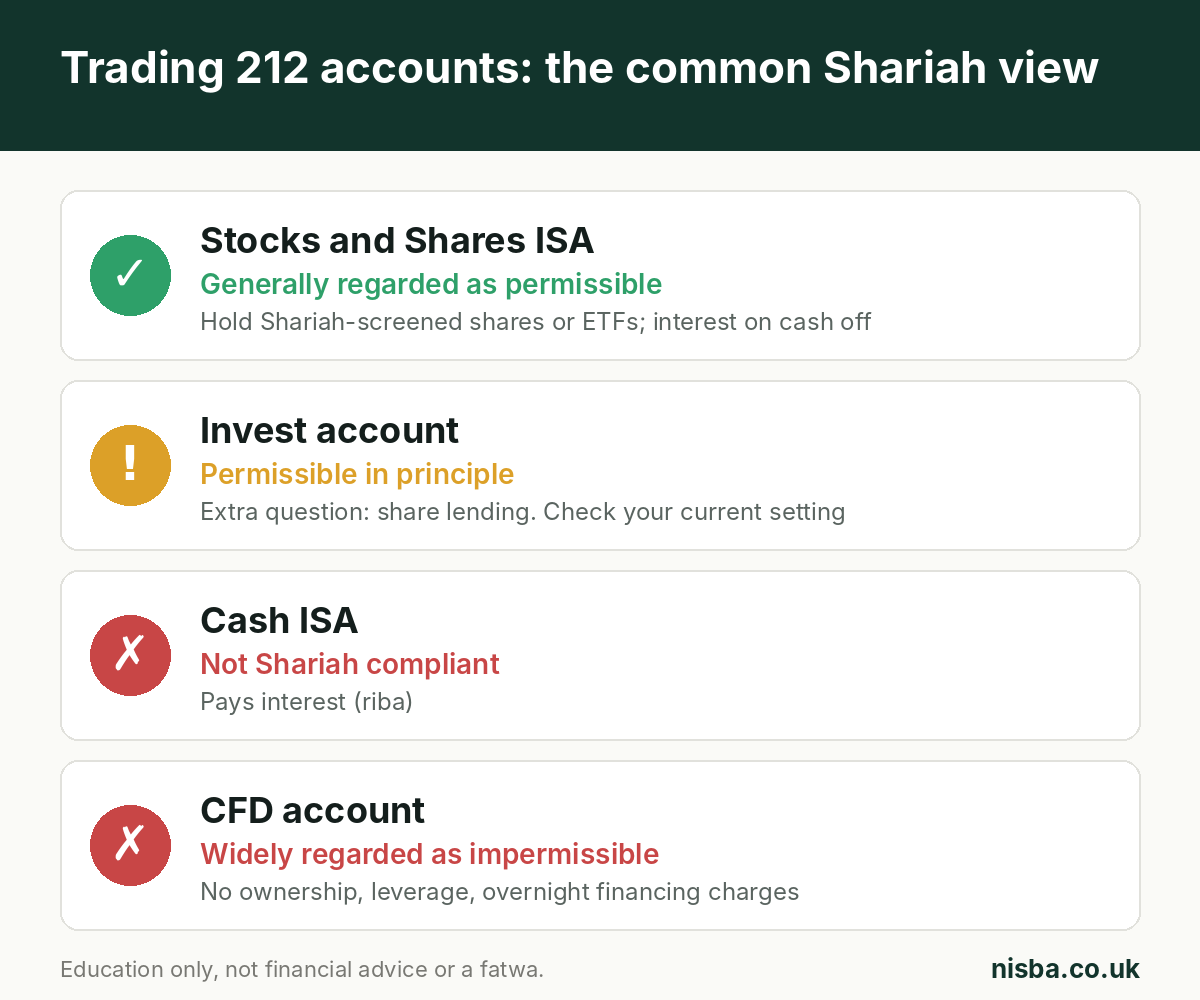
| Account | What it is | Common Shariah view |
|---|---|---|
| Stocks and Shares ISA | Real shares and ETFs inside a tax-free wrapper | Generally regarded as permissible, if what you hold is Shariah compliant and interest on cash is switched off |
| Invest account | Real shares and ETFs, taxable | Generally regarded as permissible in principle, with an extra question around share lending |
| Cash ISA | A savings account that pays interest | Interest based, so not Shariah compliant |
| CFD account | Leveraged bets on price movements | Widely regarded as impermissible |
Let's go through each one.
1. The Stocks and Shares ISA
This is the account most UK Muslims on Trading 212 use, and for good reason.
When you buy a share or an ETF in the ISA, you own a real slice of a real company. Owning part of a business that does halal work and is not heavily financed by debt is the foundation of halal investing. The ISA wrapper itself is just a tax rule: your gains and dividends are free of UK tax. There is nothing un-Islamic about a tax wrapper.
The ISA is also not part of Trading 212's share lending programme, which removes the main grey area that applies to the Invest account (more on that below).
The two things to watch:
- What you buy. An ISA full of impermissible shares is not going to be halal.
- Interest on uninvested cash. This is a setting, and it is covered in its own section below.
2. The Invest account
The Invest account works in the same way as the ISA: you buy real shares and ETFs, commission free. The difference is tax. Gains above your annual capital gains allowance and dividends above the dividend allowance can be taxable.
The Shariah question here is share lending. In the Invest account, Trading 212 can lend your shares to other market participants, who pay a fee to borrow them. Borrowed shares are often used for short selling. Under the AAOIFI Shariah standards, and in the view of most contemporary scholars, conventional share lending and short selling are not Shariah compliant.
Trading 212's terms on this have changed over the years. Earlier versions did not allow you to opt out without closing your positions. More recent versions describe a programme where lending income is split with the customer and lending can be switched off. Because the terms move, the safest approach is to check the current share lending setting in your own account and read the latest Invest terms before relying on this account.
3. The Cash ISA
Trading 212's Cash ISA is a savings product. It pays interest on your cash, often at one of the most competitive rates in the market.
That interest is riba. There is no Shariah-compliant version of this account on Trading 212, so it falls outside halal investing regardless of how good the rate is. If you want a halal home for cash, Islamic banks in the UK offer savings accounts based on expected profit rather than interest. We cover these in our guide to Islamic savings accounts in the UK.
4. The CFD account
CFD stands for Contract for Difference. You never own the underlying share. You are entering a contract that pays out based on whether a price goes up or down, usually with leverage (borrowed exposure), and with overnight financing charges for positions held open.
CFDs combine several features that scholars widely regard as impermissible: no ownership of the asset, leverage, interest-like financing charges and a high degree of speculation (gharar). Trading 212 itself publishes the percentage of retail CFD accounts that lose money, and it is a large majority. The CFD account is not part of halal investing.
Interest on uninvested cash: the setting that matters most
This is the one most people miss.
Trading 212 offers interest on uninvested cash in both the Invest account and the Stocks and Shares ISA. It is not on by default. You have to opt in. If you do, Trading 212 places your spare cash in banks and qualifying money market funds, and passes interest back to you daily.
That income is interest, so for anyone investing in line with Shariah principles, the usual approach is simply to leave this setting switched off.
Two practical points:
- If you have already earned some interest, the common scholarly view is that it should be given away to charity without the intention of reward, rather than kept or simply left in the account.
- From 6 April 2027, interest paid on cash held inside a Stocks and Shares ISA will face a flat 22% charge under the new ISA rules. For investors who already keep the setting off, this changes nothing. It is just one more reason the interest feature is less attractive than it looks.
What you buy matters more than the platform
Once you are in the right account with the right settings, the question becomes: what are you buying?
Shariah-compliant ETFs
Trading 212 does not offer traditional funds (such as the HSBC Islamic Global Equity Index Fund), only shares and ETFs. The good news is that there are Shariah-screened ETFs listed in London that are available on the app, including:
- iShares MSCI World Islamic UCITS ETF (ISWD): tracks the MSCI World Islamic Index, covering large and mid-sized companies across developed markets that pass Shariah screening. It is overseen by a Shariah panel.
- HSBC MSCI World Islamic Screened UCITS ETF (HIWS): tracks a Shariah-screened version of the MSCI World Index.
Availability on the app can change, so it is worth searching for the ticker before planning around any specific ETF. Charges, holdings and screening methods differ between ETFs, and each provider's factsheet sets these out.
Individual shares and pies
Trading 212 lets you build "pies": a basket of shares and ETFs you can invest into in one go. If you choose individual companies, each one needs checking for:
- Business activity: no alcohol, gambling, conventional banking or insurance, and so on
- Financial ratios: limits on debt, cash and interest-bearing assets relative to the company's size
- Ongoing compliance: a company that passes today can fail next year, as we explained in what happens when your halal stock turns non compliant
You may also need to purify a small portion of dividends where a company has a small amount of non-compliant income.
A quick checklist for Muslim investors on Trading 212
These are the points Muslim investors commonly check when using the app:
- Interest on cash is switched off in every account
- The CFD account is not used
- The Cash ISA is not used for halal savings
- In the Invest account, the current share lending setting has been checked
- Every holding, or the ETF holding it, passes Shariah screening
- Any interest already earned has been purified
Frequently asked questions
Is Trading 212 halal?
Trading 212 is a platform rather than a product. The Stocks and Shares ISA and Invest account let you buy real shares and ETFs, which is generally regarded as permissible when the holdings are Shariah compliant and interest on cash is off. The Cash ISA pays interest and the CFD account involves leverage and financing charges, so neither is regarded as Shariah compliant.
Is the Trading 212 Stocks and Shares ISA halal?
The ISA is a tax wrapper. It is generally regarded as halal to use when the shares or ETFs inside it pass Shariah screening and interest on uninvested cash is switched off. It is also outside Trading 212's share lending programme.
Is Trading 212 interest on cash halal?
No. The interest comes from banks and money market funds and is riba. It is an opt-in setting, so it can simply be left off. Interest already received is commonly given to charity.
Is the Trading 212 Cash ISA halal?
No. It is an interest-paying savings account. UK Islamic banks offer savings accounts based on expected profit instead.
Are Trading 212 CFDs halal?
CFDs are widely regarded as impermissible because you do not own the asset, they usually involve leverage, and positions carry overnight financing charges.
Does Trading 212 lend my shares?
Share lending applies to the Invest account, not the ISA. The terms have changed over time, so the current setting and terms in your own account are the place to check.
Can I buy the HSBC Islamic Global Equity Index Fund on Trading 212?
No. It is a traditional fund rather than an ETF, and Trading 212 only offers shares and ETFs. Shariah ETFs such as ISWD and HIWO are the ETF equivalents investors usually look at on the app.
Want to go deeper?
Knowing which account to use is step one. Knowing what to put in it, how much, and for how long is where most people get stuck. The Nisba Academy walks you through our six-step framework for halal investing, from setting goals to choosing investments, with weekly live sessions and a full money back guarantee.
This article is for education only. It is not financial advice, a personal recommendation or a fatwa. Investments can fall as well as rise and you may get back less than you put in. Tax rules can change and depend on your circumstances. If you have a specific Shariah question, speak to a scholar you trust.
Learn more about Halal Investing
Stay up to date with halal investing
Join our mailing list for the latest insights, updates, and opportunities from Nisba.
We respect your privacy, no spam, ever.