Nest Sharia Fund Explained: Performance, Charges, Holdings and How to Switch
Oct 26, 2026
The short answer: the Nest Sharia Fund is the Shariah-screened fund option inside Nest, the UK's largest workplace pension scheme. Since late 2024 it has held roughly 70% in a passive Islamic global equity fund run by HSBC and 30% in sukuk. Members pay the same charges as every other Nest fund (1.8% of each contribution plus 0.3% a year of the pot), and switching to it is free and done online. Over the five years to 30 June 2026, Nest reports that it was the best performing of its main funds.
Millions of UK workers are enrolled into Nest automatically, and many Muslim members only discover the Sharia Fund after asking whether their pension is halal. This guide explains what the fund holds, how it has performed, what it costs, the current debate over one of its underlying holdings, and how members commonly move into it.
What is the Nest Sharia Fund?
Nest (the National Employment Savings Trust) is the government-backed workplace pension scheme set up for automatic enrolment. New members are normally placed in a Nest Retirement Date Fund, which holds conventional bonds and interest-bearing assets alongside shares. Those default funds are not designed to be Shariah compliant.
The Sharia Fund is one of a small number of alternative funds members can choose. Nest describes it as investing in "Sharia-compliant company shares and sukuk", screened by Islamic scholars, and excluding companies that earn money from activities such as alcohol, pork and adult entertainment, as well as interest-paying investments like corporate and government loans. Nest also notes that anyone can choose it, not only Muslims.
What does the fund invest in?
The fund does not pick stocks itself. It invests through underlying funds managed by HSBC Asset Management.
| Part of the fund | Approximate weight | What it holds |
|---|---|---|
| Islamic global equities | About 70% | HSBC Islamic Global Equity Index Fund, a passive fund of around 515 large global companies |
| Sukuk | About 30% | Sukuk, sometimes described as Islamic bonds, giving a share in assets or their income rather than an interest-bearing loan |
| Screening | Applied throughout | Business activity screens plus financial ratio limits on debt and interest income, overseen by HSBC's Shariah committee |
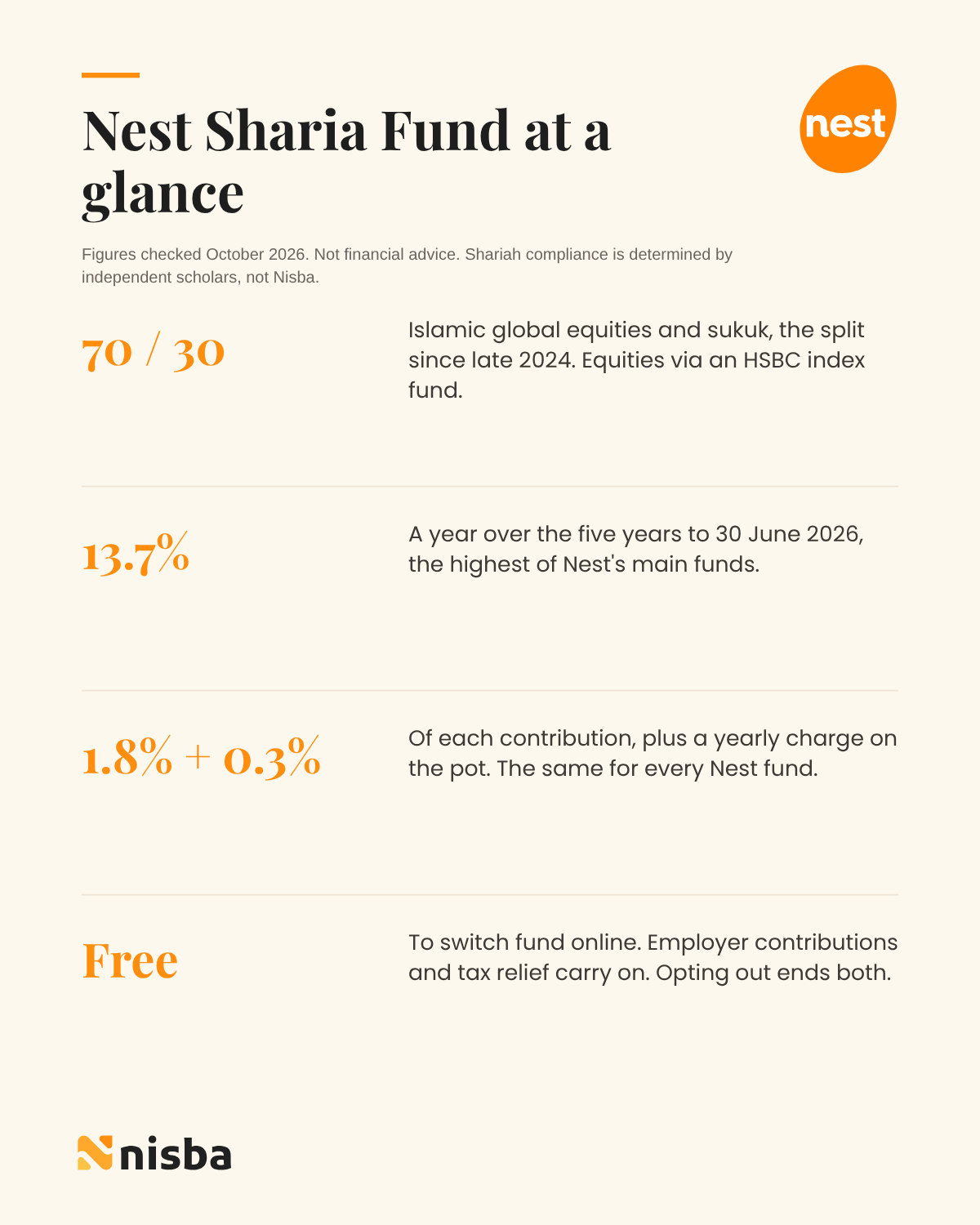
Until November 2024 the fund was 100% equities. Nest then introduced the 30% sukuk allocation, which industry press described as a way to lower volatility and bring Shariah members closer to the risk level of mainstream default funds.
The equity fund changed its index on 23 March 2026, from the Dow Jones Islamic Market Titans 100 (about 100 of the largest Shariah-compliant companies) to the much broader S&P Global 1200 Shariah Select Index. According to HSBC's factsheet dated 30 September 2026, the largest holdings were NVIDIA (8.4%), Apple (7.4%), Microsoft (5.8%), Alphabet (5.6%) and Amazon (3.7%), followed by Taiwan Semiconductor, Broadcom, Meta, Micron and Tesla. The fund remains heavily weighted to large US technology companies, which is typical of Islamic equity indices because many banks, insurers and highly indebted businesses are screened out.
Nest Sharia Fund performance
Nest publishes five-year and since-launch figures for each fund on its compare fund performance page. The figures below are as at 30 June 2026.
| Nest fund | 5-year cumulative | 5-year annualised | Annualised since launch |
|---|---|---|---|
| Sharia Fund | 90.1% | 13.7% | 14.6% |
| Higher Risk Fund | 55.3% | 9.2% | 10.3% |
| 2046 Retirement Date Fund (growth phase) | 45.6% | 7.8% | 8.9% |
| Ethical Fund (growth phase) | 19.9% | 3.7% | 8.6% |
| Lower Growth Fund | 15.6% | 2.9% | 1.4% |
Nest's own illustration shows £1 invested five years earlier growing to about £1.90 by 30 June 2026.
A few points help put these numbers in context:
- Most of this record was built as a 100% equity fund. The sukuk allocation only arrived in late 2024, so future returns and swings are likely to look different from the past.
- Concentration cuts both ways. Strong returns from large US technology shares drove much of the outperformance. The same concentration produced weak patches, such as a roughly flat 12 months to mid 2025 reported by some reviewers.
- Higher risk. Nest states that the Sharia Fund "carries higher investment risk" than its other funds because it invests in only two types of market.
- Past performance is not a guide to the future.
Nest Sharia Fund charges
Nest applies the same charges to every fund, including the Sharia Fund:
- Contribution charge: 1.8% of each contribution paid in.
- Annual management charge: 0.3% a year of the total pot.
There is no extra charge for choosing the Sharia Fund, and Nest says it does not charge for transferring out. The contribution charge means the effective cost is higher for members who are still paying in large amounts relative to their pot, and lower for long-standing members with a large pot. For a side by side look at how this compares with other Shariah pension options, see our guide to the cheapest halal pension in the UK.
The Palantir question and BDS concerns
In October 2026, the investigative outlet Hyphen reported that the HSBC Islamic Global Equity Index Fund had bought around $38 million of Palantir shares in the first half of 2026, after the switch to the broader S&P index. Palantir signed a strategic partnership with Israel's Ministry of Defense in January 2024.
Following the reports, HSBC said it would review the holding with independent advisers. Hyphen reported that Nest had begun discussions with HSBC, and the Financial Times reported that The People's Pension also raised concerns. At the time of writing, no outcome had been announced.
This highlights a point that many investors overlook: standard Shariah screens focus on a company's main business activity and its financial ratios. They do not usually assess involvement in military occupation or human rights concerns, which is why some Muslim investors also apply ethical or BDS (Boycott, Divestment and Sanctions) screens. Nisba has covered the wider issue in HSBC funds complicit in genocide?, and what happens when a halal stock turns non compliant explains how index changes like this flow through to funds.
Is the Nest Sharia Fund halal?
The fund follows a widely used Shariah screening approach broadly in line with AAOIFI standards: excluding prohibited sectors, capping debt and interest income using financial ratios, and purifying small amounts of non-compliant income. On that basis, it is commonly regarded as a Shariah-compliant option for workplace pension savings.
Views do differ on some points:
- Screening thresholds. Some scholars and investors prefer stricter ratio limits than those used by major index providers.
- Ethical and BDS concerns. As the Palantir case shows, a fund can pass a Shariah screen while holding companies some Muslims object to on other grounds.
- The pension wrapper. Mainstream contemporary opinion generally regards tax relief and employer contributions to a defined contribution pension as permissible, with the main question being where the money is invested. Zakat on pension pots is an area where scholars take different approaches.
For a background on the principles, see what is halal investing.
How to switch to the Nest Sharia Fund
Nest's help centre describes the process as:
- Log in to your Nest online account.
- On the dashboard, select "Learn more about your fund".
- Select "View all of our Nest fund options" and open the Sharia Fund.
- Select "Switch to this fund" and follow the on-screen instructions.
Nest's live chat can answer questions about timings and how existing savings and future contributions are treated.
Switching versus opting out
Many Muslim employees opt out of their workplace pension because the default fund is not Shariah compliant. Under automatic enrolment rules, employers must contribute at least 3% of qualifying earnings, with a minimum of 8% in total. Opting out within one month of being enrolled refunds the employee's own payments, but it also ends the employer's contributions and the tax relief. Employers must also re-enrol eligible staff every three years. For these reasons, switching fund rather than opting out is the usual approach discussed among Muslim pension savers.
Transferring out of Nest
Some online guides suggest moving money from Nest into a Shariah-compliant SIPP (self-invested personal pension) while still employed. Nest's own transfer page states that members who are still making contributions cannot transfer out of Nest. Rules and options can vary, so members considering a transfer commonly confirm directly with Nest first.
Frequently asked questions
Is the Nest pension halal?
Nest's default Retirement Date Funds hold conventional bonds and interest-bearing assets, so they are not designed to be Shariah compliant. The Nest Sharia Fund is the scheme's Shariah-screened option and is commonly regarded as compliant by mainstream screening standards, although some investors raise ethical and BDS concerns about individual holdings.
What is the Nest Sharia Fund invested in?
About 70% in the HSBC Islamic Global Equity Index Fund, which tracks the S&P Global 1200 Shariah Select Index, and about 30% in sukuk.
How has the Nest Sharia Fund performed?
Nest reports 90.1% cumulative growth over the five years to 30 June 2026, or 13.7% a year, compared with 9.2% a year for the Higher Risk Fund. Most of that period was before the 30% sukuk allocation was added.
What are the Nest Sharia Fund charges?
The same as all Nest funds: 1.8% of each contribution and 0.3% a year of the pot.
Is the Nest Sharia Fund high risk?
Nest describes it as carrying higher investment risk than its other funds because it invests in only two types of market and is concentrated in large technology companies. The sukuk allocation added in 2024 was intended to reduce volatility.
Can I switch to the Nest Sharia Fund at any time?
Yes. Nest allows members to change fund through their online account, and there is no charge for choosing the Sharia Fund.
Does the Nest Sharia Fund hold Palantir?
The HSBC equity fund it invests in bought Palantir shares in 2026. HSBC announced a review in October 2026, and Nest said it was in discussions with HSBC. Checking the latest factsheet is the most reliable way to see current holdings.
Learn more
If you want to check the Shariah and BDS status of the funds in your pension or ISA, the Halal Screener screens funds for both, and can export compliant portfolios as pies to Trading 212. For a structured way to build a halal investing plan from scratch, the Nisba Academy is a one-month course built around a six-step framework, with a money back guarantee. You may also find our article on lifestyling and managing risk as you approach retirement useful alongside this guide.
This article is for education only and is not financial advice or a personal recommendation. Nisba does not make religious rulings: whether an investment is Shariah compliant is determined by the independent scholars who approve it. Investments can fall as well as rise and you may get back less than you put in. Tax rules can change and depend on your circumstances.
Learn more about Halal Investing
Stay up to date with halal investing
Join our mailing list for the latest insights, updates, and opportunities from Nisba.
We respect your privacy, no spam, ever.