
Are Pensions Halal? NHS, Teachers, Workplace and State Pensions Explained
Nov 02, 2026
The short answer: most scholars who have written on UK pensions do not regard having a pension as the problem in itself. The Shariah question depends on the type of pension. For defined contribution pensions (most private sector workplace pensions, including Nest), the main issue is which fund the money is invested in. For public sector defined benefit schemes such as the NHS and teachers' pensions, published scholarly answers have generally treated membership as permissible, although some scholars raise concerns about the contract. The state pension is widely regarded as uncontroversial.
This guide explains each type of UK pension, where the Shariah questions sit and what scholars have said.
Why the type of pension matters
There are three broad kinds of pension in the UK, and they work in very different ways.
Defined contribution (DC) pensions build a pot. You and your employer pay in, the money is invested in funds, and what you have at retirement depends on how those investments perform. Most private sector workplace pensions and all personal pensions and SIPPs work this way.
Defined benefit (DB) pensions promise an income based on a formula, usually your salary and years of service. You do not choose investments and the amount you receive does not depend directly on market returns. Most public sector pensions are DB, as are older "final salary" schemes in the private sector.
The state pension is paid by the government to people who have built up enough National Insurance years. It is not an investment pot at all.
The Shariah question follows the structure. With a DC pot, the question is mainly about what the money is invested in. With a DB scheme, there is no fund choice, so the discussion turns to the nature of the contract itself.
| Pension type | Examples | Do you choose the investments? | Where the Shariah discussion usually sits |
|---|---|---|---|
| Unfunded defined benefit | NHS, Teachers' Pension Scheme, Civil Service, armed forces, police | No | Whether the contract and the benefit formula are acceptable |
| Funded defined benefit | Local Government Pension Scheme (LGPS), older company final salary schemes | No | The contract, plus the fact that the scheme's assets include interest bearing investments |
| Defined contribution | Nest, People's Pension, most workplace pensions, SIPPs | Yes | Whether the chosen fund is Shariah compliant |
| State pension | New State Pension | No | Commonly regarded as uncontroversial |
Public sector pensions: NHS, teachers and civil service
The NHS Pension Scheme, the Teachers' Pension Scheme and the Civil Service schemes are unfunded defined benefit schemes. This means there is no large pot of investments behind them. Employer and member contributions are paid to the government, and pensions are paid out of public funds. The Teachers' Pension Scheme, for example, is described as "pay as you go": contributions go to central government and pensions in payment are met from public funds.
Because there is no investment fund, the usual concern about interest bearing bonds or non compliant shares does not arise in the same way. Instead, you build up a pension each year according to a formula. In the NHS 2015 scheme this is 1/54 of pensionable pay each year, revalued while you are working by CPI plus 1.5%. In the teachers' career average scheme it is 1/57 of pensionable earnings, revalued by CPI plus 1.6%.
What scholars have said:
- A Hanafi answer published by the Fatwa Centre (approved by Mufti Abdul Rahman Mangera and Mufti Zubair Patel) states that it is permissible to join the NHS Pension Scheme, on the basis that it is a defined benefit scheme.
- Mufti Zubair Butt's Al-Qalam research paper, Pensions and Gross Uncertainty, takes a stricter Hanafi view. As summarised by Islamic Finance Guru, the paper treats final salary benefits as deferred salary that may be taken, but considers the underlying contract defective because of gross uncertainty (gharar) about what will eventually be paid.
- Islamic Finance Guru's writer disagrees that taking such a pension is sinful, arguing that the benefit formula uses precise figures and is not grossly uncertain.
A question sometimes raised is whether the inflation linked revaluation (CPI plus a fixed percentage) resembles interest. The scholarly opinions summarised in this article generally describe DB benefits as a contractual entitlement under the employment contract, a form of deferred wages, rather than a return on money lent. Some individual scholars do raise the question, so this is an area where views differ and many people ask a scholar they trust about their specific scheme.
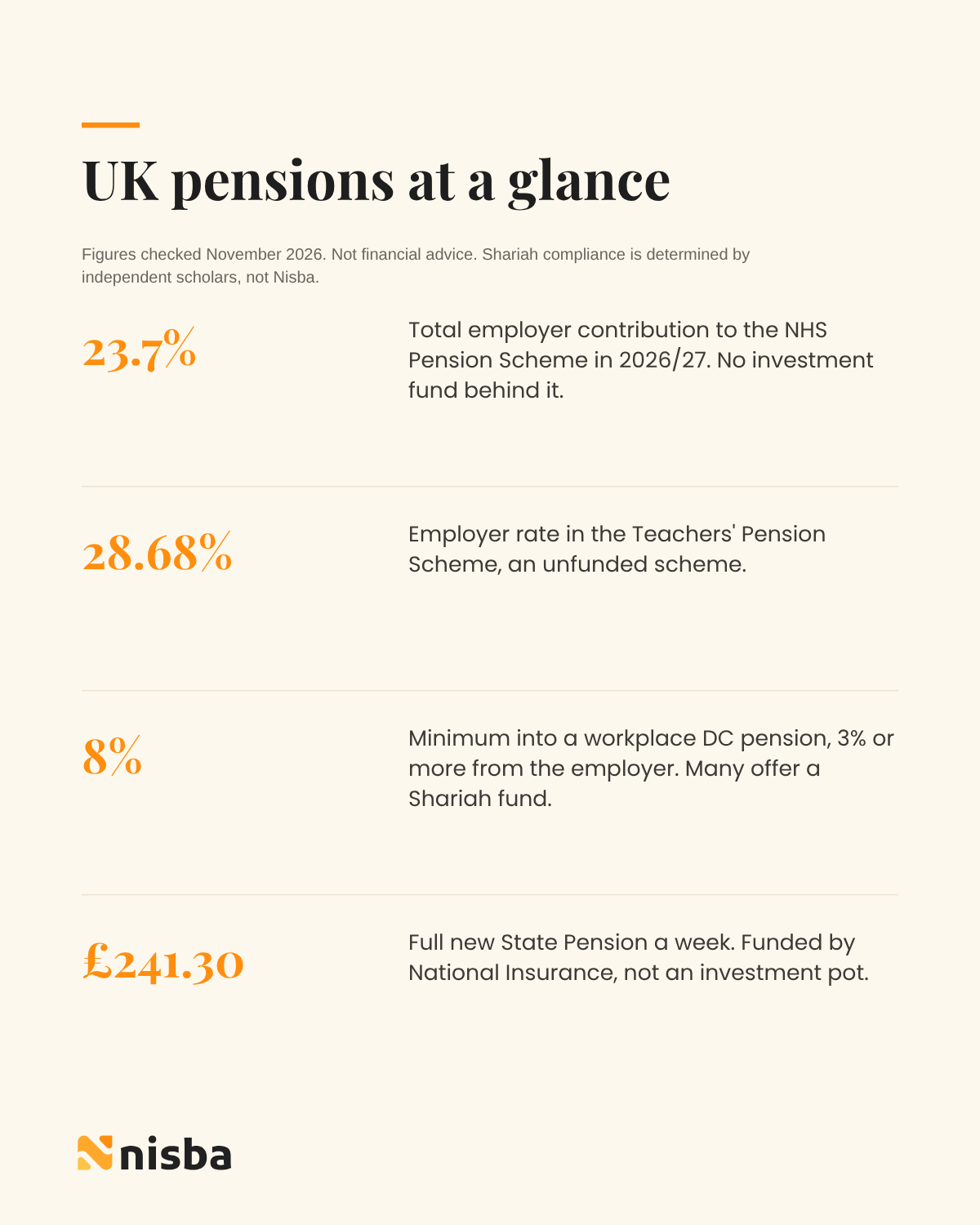
The contributions involved are significant. For 2026/27 the total employer contribution to the NHS scheme is 23.7% of pensionable pay (14.38% paid by the employer and 9.4% paid centrally). Members pay between 5.2% and 12.5% depending on pay. In the Teachers' Pension Scheme the employer rate is 28.68%, with members paying between 7.4% and 12%.
The Local Government Pension Scheme (LGPS)
The LGPS is different from the NHS and teachers' schemes because it is funded: contributions are invested in a large pool of assets, which includes bonds and other interest bearing investments. Members cannot choose these investments.
The LGPS Scheme Advisory Board commissioned an independent Islamic finance scholar to review the scheme. According to the Greater Manchester Pension Fund, the opinion concluded that membership of the LGPS is Shariah compliant, on the basis that contributions are treated as part of wages rather than a loan, and that benefits are contractual entitlements that do not depend on interest rates. The report also recommended that the LGPS consider offering Shariah compliant investment sub funds in future, which would require legislation. Some LGPS funds already offer a Shariah compliant option for additional voluntary contributions (AVCs).
The Board also took legal advice in 2022 from barrister Lydia Seymour on whether employers need to offer a Shariah compliant alternative. That advice noted that whether the LGPS is Shariah compliant "is not a simple one" and "is subject to differing views among Islamic scholars", and recorded that some employees had opted out of the scheme on religious grounds.
Islamic Finance Guru notes that because members of funded DB schemes do not control the investments, purification of income from those investments is not required of them.
Workplace defined contribution pensions, including Nest
Most private sector employees are auto-enrolled into a defined contribution workplace pension. The legal minimum is 8% of qualifying earnings, of which at least 3% must come from the employer.
For DC pensions, the mainstream position is straightforward: a pension pot is a tax wrapper, and what matters is where the money is invested. Islamic Finance Guru summarises it as making sure that "where this money is being invested, is sharia-compliant." The default fund in most schemes is not Shariah compliant, because it typically holds conventional shares and bonds. Many schemes, however, offer a Shariah fund that can be selected instead of the default.
Common examples include:
- Nest: the Nest Sharia Fund. See our Nest Sharia Fund guide for its charges, holdings and how the switch works.
- Aviva, Scottish Widows, Legal & General, Standard Life, Aegon and others: many of these schemes offer a Shariah option, often based on the HSBC Islamic Global Equity Index Fund. Availability depends on the specific employer scheme.
- SIPPs: personal pensions offer a wider choice of Shariah compliant funds and ETFs. Our halal pension fees comparison sets out what the main providers charge.
Shariah compliant funds are approved by their own Shariah boards, and some investors also look at other screens, such as exposure to companies linked to the occupation of Palestine. Our article on HSBC funds and BDS concerns covers that debate.
One further point relates to retirement itself. Mufti Zubair Butt's paper is reported as being against buying a conventional annuity, because of the arguments that apply to insurance type contracts. Other options at retirement, such as drawdown from a pot invested in Shariah compliant funds, do not raise the same issue.
The state pension
The state pension is funded through National Insurance contributions, which are compulsory for workers and are not invested on your behalf. Islamic Finance Guru describes it as having "nothing very controversial about this from a fiqhi view", and this is the commonly held position. The full new State Pension is £241.30 a week, and it rises each year in line with the highest of earnings growth, inflation or 2.5%.
What opting out involves
Some Muslims opt out of workplace pensions altogether because of Shariah concerns. It is worth understanding what that usually means in practice:
- Employer contributions stop. In a DB public sector scheme these are often worth more than 20% of salary, and in a DC scheme at least 3% of qualifying earnings.
- Tax relief stops. Pension contributions receive tax relief at your marginal rate, which other ways of saving generally do not.
- In a DC scheme, switching fund is usually an alternative. For DC schemes, most of the scholarly discussion is about fund choice rather than membership, so moving to a Shariah fund addresses the main concern without leaving the scheme.
For public sector DB schemes, where no fund choice exists, the decision is more often discussed with a scholar, since published opinions on these schemes vary in their reasoning.
How many Muslims check their own pension
The usual approach looks something like this:
- Find out the pension type. Your payslip, scheme website or HR team will tell you whether it is DB or DC.
- For a DC pension, check the fund. Log in to the provider's website and look at which fund your contributions go into. If it is the default, check the list of alternatives for a Shariah fund.
- Check what the Shariah fund holds and costs. Fund factsheets list the Shariah board, the index and the charges.
- For a DB pension, read the scheme guide and consider the published opinions. Where a scheme offers Shariah AVCs, that is a separate option for any extra contributions.
- Look at old pensions too. Pots from previous jobs often sit in default funds.
Frequently asked questions
Are pensions halal?
Having a pension is not generally regarded as haram in itself. For defined contribution pensions, the mainstream view is that the pension is permissible when the money is invested in Shariah compliant funds. For defined benefit schemes, published scholarly answers have generally permitted membership, with some scholars raising concerns about the contract.
Is the NHS pension halal?
The NHS Pension Scheme is an unfunded defined benefit scheme with no investment fund behind it. A Hanafi answer from the Fatwa Centre states that joining it is permissible. Other scholars, such as Mufti Zubair Butt, permit taking the benefits but consider the contract defective because of uncertainty. Views differ, so many NHS staff consult a scholar they trust.
Is the teachers' pension halal?
The Teachers' Pension Scheme is also an unfunded, pay as you go defined benefit scheme, so the same discussion as for the NHS scheme applies. There is no fund choice in the main scheme.
Is the civil service pension halal?
Civil Service pensions are unfunded defined benefit schemes too, so the scholarly discussion follows the same reasoning as for the NHS scheme.
Is the state pension halal?
The state pension is funded by National Insurance and is not an investment. It is commonly regarded as uncontroversial from a Shariah point of view.
Is a Nest pension halal?
Nest is a defined contribution scheme. Its default funds are not Shariah compliant, but members can switch to the Nest Sharia Fund. Our Nest Sharia Fund guide explains how the switch works.
Is a pension halal in the Hanafi school?
Hanafi scholars have reached different conclusions on defined benefit schemes. The Fatwa Centre answer permits joining the NHS scheme, while the Al-Qalam paper by Mufti Zubair Butt permits taking final salary benefits but considers the contract defective. For defined contribution pensions, Hanafi and other scholars generally focus on whether the chosen fund is Shariah compliant.
Learn the full picture
Pensions are one part of a halal investing plan, alongside ISAs and savings. The Nisba Academy is a one month course that takes you through Nisba's six step framework, from setting goals to choosing account types and funds, with a money back guarantee.
Related reading:
- Nest Sharia Fund explained
- The cheapest halal pension in the UK
- Lifestyling: managing risk as you approach retirement
- Halal ISA UK: every ISA type explained
This article is for education only and is not financial advice or a personal recommendation. Nisba does not make religious rulings: whether an investment is Shariah compliant is determined by the independent scholars who approve it. Investments can fall as well as rise and you may get back less than you put in. Tax rules can change and depend on your circumstances.
Learn more about Halal Investing
Stay up to date with halal investing
Join our mailing list for the latest insights, updates, and opportunities from Nisba.
We respect your privacy, no spam, ever.