
Wahed Invest Review UK: Fees, Portfolios, Shariah Screening and How It Works
Oct 30, 2026
The short answer: Wahed is a UK authorised, Shariah screened "robo adviser". You answer a risk questionnaire, it places you in one of six ready made portfolios of Islamic equity funds, sukuk and gold, and it rebalances for you. Its fee is 1% a year on the first £250,000, with no monthly minimum, plus the running costs of the funds inside the portfolio. It offers a Stocks and Shares ISA, a general investment account and a SIPP, but no Junior ISA. Whether it suits someone depends mostly on how much they invest and how much they value having the choices made for them.
What is Wahed?
Wahed Invest Ltd is a London based investment manager, authorised and regulated by the Financial Conduct Authority (firm reference number 833225). The wider group started in the United States in 2015.
The model is simple. Rather than choosing individual funds or shares, you complete a questionnaire about your goals and attitude to risk. Wahed then allocates your money to one of six portfolios and keeps it in line with that mix over time. This is the main difference from a do it yourself platform such as Trading 212, where the investor picks every holding. We cover that approach in Is Trading 212 halal?
Wahed UK at a glance
| Feature | Detail (checked October 2026) |
|---|---|
| Regulator | FCA, firm reference number 833225 |
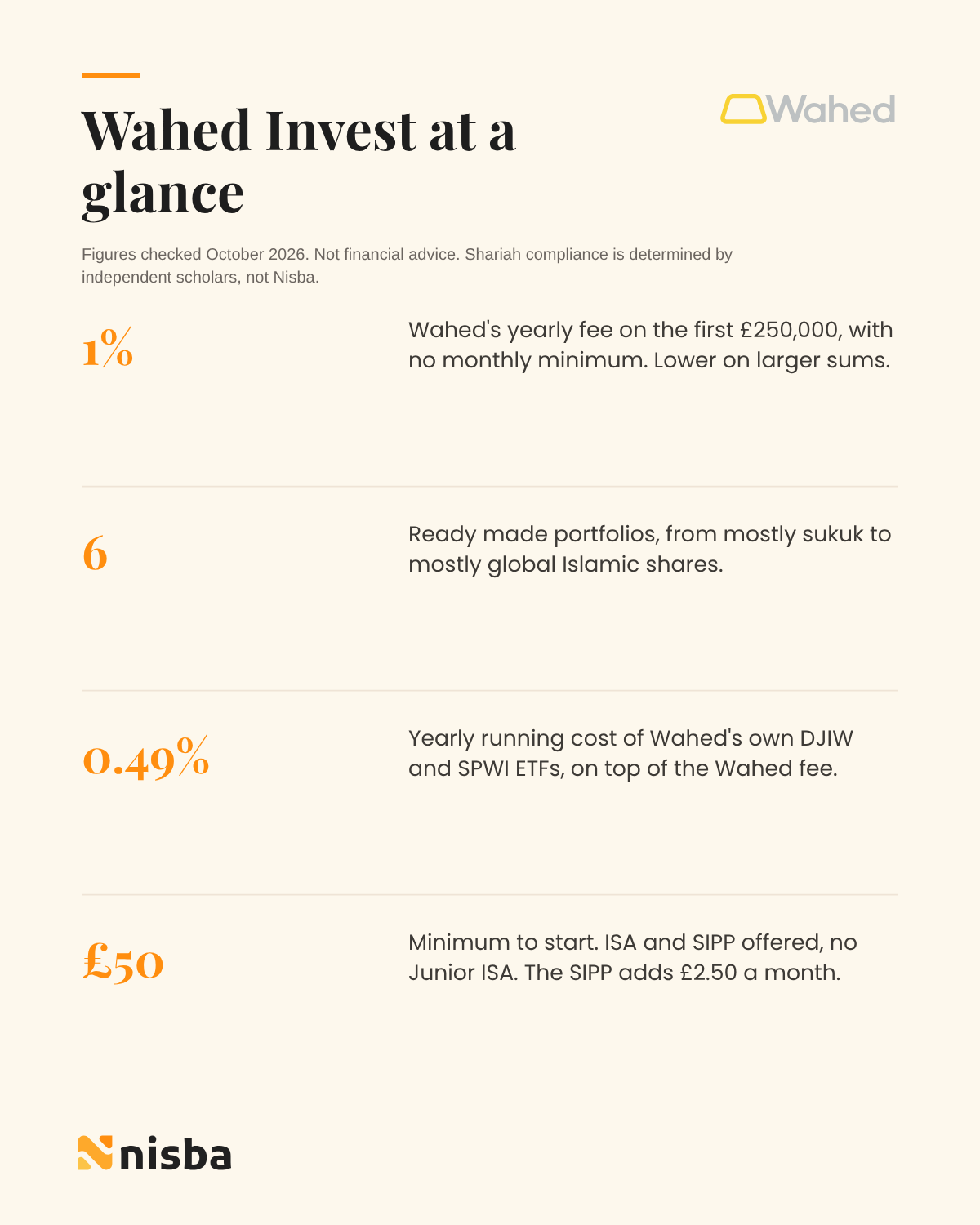
| Minimum to start | £50 |
| Accounts | Stocks and Shares ISA, General Investment Account, Business Investment Account, SIPP (personal pension) |
| Junior ISA | Not offered: Wahed states accounts are for over 18s only |
| Wahed fee | 1% a year up to £250,000, 0.75% from £250,000 to £1 million, 0.5% above £1 million |
| Minimum fee | None: the 1% applies whatever the balance |
| SIPP extra | £2.50 a month maintenance fee |
| Wahed's own ETFs | DJIW and SPWI, each with a 0.49% total expense ratio |
| Shariah adviser | Shariyah Review Bureau (SRB) |
| FSCS | Up to £85,000 per person if the firm fails (not for investment losses) |
How Wahed's fees work
Wahed's charges come in two main layers: its own fee and the costs of the funds inside the portfolio.
1. The Wahed fee
Wahed charges 1% a year on the first £250,000, billed monthly. The rate falls to 0.75% on the part of a portfolio between £250,000 and £1 million, and to 0.5% on anything above £1 million. The tiers are marginal, so a £300,000 portfolio pays 1% on the first £250,000 and 0.75% on the remaining £50,000.
There is no monthly minimum fee, so the 1% applies at every balance, and an account with a £0 balance is not charged.
2. Fund costs
The Wahed fee does not include the running costs of the funds in the portfolio. Wahed's own ETFs, DJIW and SPWI, each show a total expense ratio of 0.49%. The sukuk funds and the gold ETC carry their own charges, which Wahed's pricing page does not list as a single figure. Market spreads when funds are bought and sold are a further, smaller cost.
What the Wahed fee comes to at different balances
| Balance | Annual Wahed fee | As a % of the balance |
|---|---|---|
| £1,000 | £10 | 1.0% |
| £5,000 | £50 | 1.0% |
| £10,000 | £100 | 1.0% |
| £50,000 | £500 | 1.0% |
| £300,000 | £2,875 | 0.96% |
These figures exclude fund costs and, for a SIPP, the extra £30 a year maintenance fee. A £10,000 SIPP would therefore pay £130 a year to Wahed before fund costs.
Many investors compare the total cost, platform plus funds, against alternatives. Our cheapest halal pension article sets out how those comparisons are usually made for pensions.
A note on older fee information
Some older reviews, and some older Wahed pages and brochures, still mention the £2.99 monthly minimum or a previous 0.99% and 0.49% fee structure. These describe earlier pricing. Wahed's current pricing page and client agreement are the documents that apply.
The six Wahed portfolios
Wahed's UK portfolios run from Very Conservative to Very Aggressive:
- Very Conservative: mainly sukuk, aimed at preserving capital.
- Moderately Conservative: mostly sukuk with some global shares.
- Moderate: a balance of sukuk and global shares.
- Moderately Aggressive: more global shares, with sukuk alongside.
- Aggressive: mainly global shares, with some sukuk.
- Very Aggressive: focused on global shares, with a small sukuk allocation.
Wahed's fund range page lists the building blocks used in its UK portfolios:
- DJIW: Wahed Dow Jones Islamic World UCITS ETF, which tracks the DJIM International Titans 100 Index. TER 0.49%.
- SPWI: Wahed S&P 500 Shariah UCITS ETF, which tracks the S&P 500 Shariah Index. TER 0.49%.
- Sukuk: HSBC Global Funds ICAV Global Sukuk Index Fund and the iShares Sukuk UCITS ETF.
- Gold: The Royal Mint Physical Gold ETC.
Both Wahed ETFs launched on the London Stock Exchange in January 2026, are domiciled in Ireland, and are listed as ISA and SIPP eligible. Older versions of Wahed's ISA page list other third party funds, such as iShares and HSBC Islamic index funds, so it is worth checking the current holdings in the app. If you hold the HSBC fund elsewhere, our HSBC Islamic Global Equity Index Fund review explains how it is built.
Using its own funds
Wahed's fund range page lists its own ETFs among the building blocks of its UK portfolios. Where they are held, investors pay Wahed both the platform fee and, through the ETF's expense ratio, a fund fee. Wahed discloses this. It is a common arrangement in the industry, and it is one of the things investors often look at when comparing total costs.
Is Wahed halal? How its Shariah oversight works
Nisba does not make religious rulings. What can be described is how Wahed's Shariah governance is set up.
- Shariah adviser: Wahed has appointed Shariyah Review Bureau (SRB), a Shariah advisory firm, as its Shariah committee. Wahed publishes annual Shariah reports and a certificate of compliance.
- Screening: companies are excluded for core business in alcohol, tobacco, gambling, conventional finance, adult entertainment, weapons and impermissible food, and for failing financial ratio tests on debt and similar measures. Industry standard screens of this kind are commonly based on the AAOIFI Shariah standards, and Wahed's index funds track Shariah indices from Dow Jones and S&P.
- Purification: Wahed provides an annual purification report showing the share of dividend income that came from non compliant sources, so investors can give it to charity.
- Zakat: Wahed does not pay zakat on your behalf. The usual approach is for investors to calculate it themselves, for example with the Nisba zakat calculator.
As with any Shariah screened product, scholars differ on details such as debt ratio thresholds, how to treat sukuk structures and whether index screening alone is enough. Some investors also apply ethical screens beyond the Shariah rules, such as BDS criteria. Our article on what happens when a halal stock turns non compliant explains how screened funds deal with companies that fail a later review.
Wahed ISA, SIPP and other accounts
Stocks and Shares ISA
Wahed offers a Stocks and Shares ISA within the £20,000 annual ISA allowance, and existing ISAs can be transferred in through the app. Wahed does not offer a cash ISA. The wider question of which ISAs are generally regarded as Shariah compliant is covered in our halal ISA guide.
SIPP (personal pension)
The Wahed SIPP is a self invested personal pension invested in the same portfolios, managed through the app. It accepts transfers in from most other pensions, but not from defined benefit (final salary) schemes where guarantees would be lost. It offers flexi access drawdown, and Wahed says you must take regulated advice before taking benefits. The £2.50 monthly SIPP fee is added to the usual Wahed fee. The minimum pension age is 55, rising to 57 from April 2028.
No Junior ISA
Wahed's UK FAQ states that you must be at least 18 to open an account. At least one UK review site lists a Wahed Junior ISA, but Wahed's own pages do not show one, so at the time of writing there does not appear to be a Wahed product for children.
How safe is money with Wahed?
Client investments are held with a custodian, separately from the firm's own money. If the firm failed, the Financial Services Compensation Scheme (FSCS) covers eligible investors up to £85,000 per person per firm. The FSCS limit for bank deposits rose to £120,000 in December 2025, but the investment limit stayed at £85,000. FSCS cover does not protect against investments falling in value.
Points investors commonly weigh up
| Often seen as strengths | Often raised as drawbacks |
|---|---|
| Shariah screening, purification reports and rebalancing handled for you | Fund costs are charged on top of the 1% Wahed fee |
| Simple app, £50 minimum, regular deposits | Total cost (platform plus funds) is higher than many DIY options |
| ISA, SIPP and general account in one app | No Junior ISA and no cash ISA |
| Includes sukuk and gold, which many DIY platforms do not offer easily | Limited control: you cannot choose individual funds |
| FCA authorised with FSCS protection | Withdrawals can take several working days to reach a bank account |
Investors comfortable picking funds often compare Wahed with a do it yourself approach using Shariah screened ETFs on a low cost platform, while others value a managed service and accept the higher fee. Both are common approaches.
Frequently asked questions
Is Wahed Invest halal?
Wahed's portfolios are overseen by its Shariah adviser, Shariyah Review Bureau, and screened by sector and financial ratios. Whether a product is Shariah compliant is determined by the independent scholars who approve it, and scholars can differ on details.
Is Wahed safe and regulated in the UK?
Wahed Invest Ltd is FCA authorised (FRN 833225), client assets are held separately from the firm's own money, and the FSCS covers eligible investors up to £85,000 if the firm fails, though not investment losses.
What are Wahed's fees in the UK?
1% a year on the first £250,000 (lower above that), with no monthly minimum, plus fund costs and £2.50 a month extra for the SIPP.
What is the minimum investment with Wahed?
Wahed states the minimum to activate an account is £50.
Does Wahed have an ISA?
Yes, a Stocks and Shares ISA. It does not offer a cash ISA, a Lifetime ISA or a Junior ISA.
Can I transfer my pension to Wahed?
Wahed's SIPP accepts transfers from most registered pension schemes, but not from defined benefit schemes where guarantees would be lost. It is usual to check exit fees and any lost benefits on the old pension first.
How long do Wahed withdrawals take?
Investments are normally sold within two business days. Wahed says it can take up to 10 working days for money to reach a bank account, once settlement and checks are complete.
Learning to compare halal platforms yourself
The Nisba Academy is a one month course built around a six step framework, covering how to set goals, choose accounts, read fund costs and build a Shariah screened portfolio yourself. It comes with a money back guarantee.
For background on the principles, start with halal investing for beginners.
This article is for education only and is not financial advice or a personal recommendation. Nisba does not make religious rulings: whether an investment is Shariah compliant is determined by the independent scholars who approve it. Investments can fall as well as rise and you may get back less than you put in. Tax rules can change and depend on your circumstances.
Learn more about Halal Investing
Stay up to date with halal investing
Join our mailing list for the latest insights, updates, and opportunities from Nisba.
We respect your privacy, no spam, ever.