Halal ETFs UK: How Shariah Compliant ETFs Work and Which Are Available
Nov 10, 2026
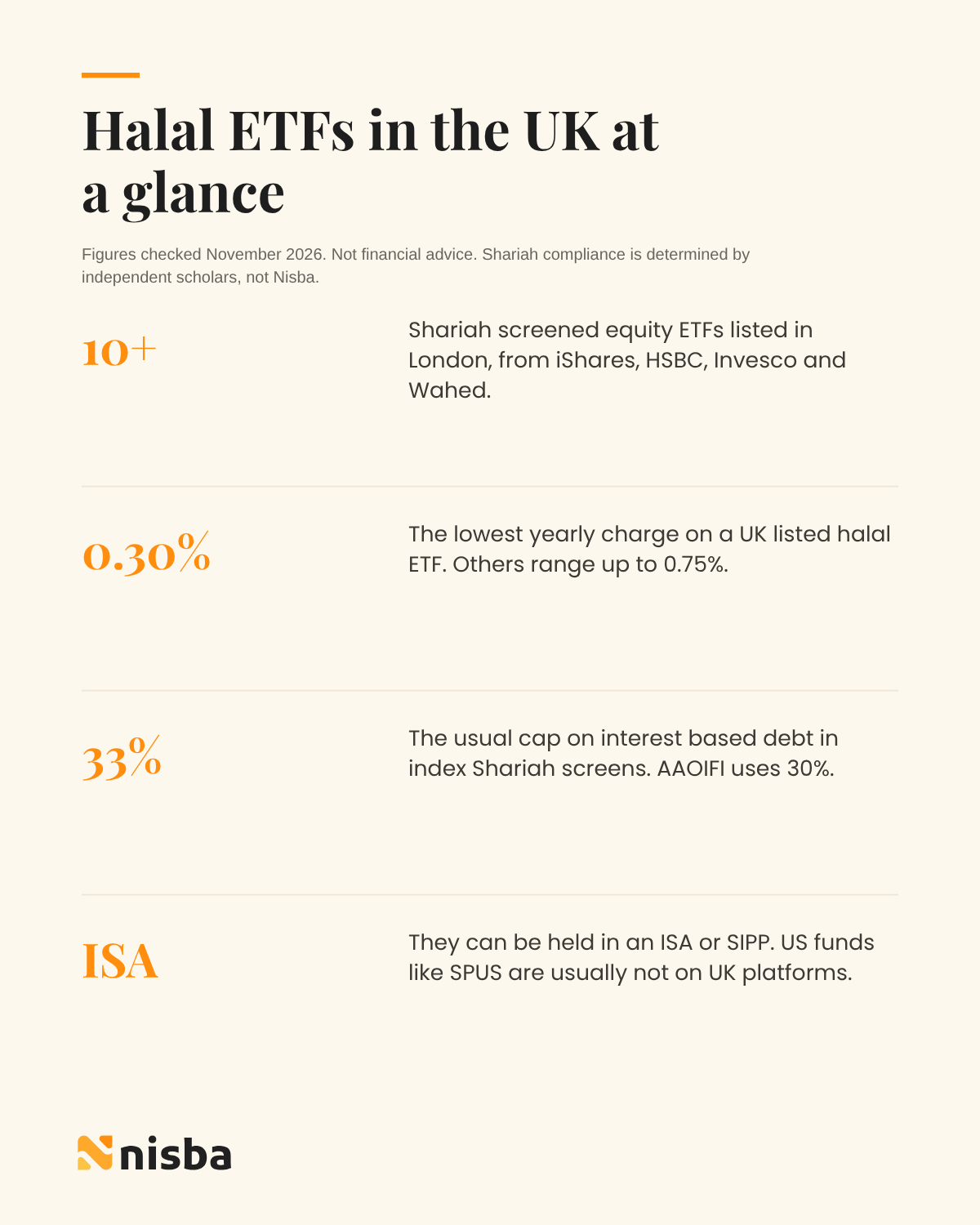
A halal ETF, more precisely a Shariah compliant ETF, is an exchange traded fund that only holds investments passing a set of Shariah screens. The fund itself is run by an investment company such as iShares, HSBC, Invesco or Wahed. The list of companies it holds is set by an index provider such as MSCI or S&P Dow Jones, and index providers sometimes outsource the Shariah screening to specialist firms such as Ratings Intelligence. UK investors can buy a growing number of these ETFs on the London Stock Exchange, with ongoing charges of roughly 0.30% to 0.75% a year.
This guide is about Shariah compliant equity ETFs, meaning funds that hold company shares. Sukuk ETFs also exist, but they are screened in a different way and are not covered here. The guide describes how the screening works and some of the equity ETFs listed in the UK, without recommending any of them.
What makes an ETF halal?
An ETF is a fund that trades on a stock exchange like a share. Most ETFs track an index, so a Shariah compliant equity ETF is usually only as compliant as the index behind it. That index applies two kinds of screen.
1. Business activity screens. Companies are excluded if their core business is impermissible: conventional banking and insurance, alcohol, pork, gambling, adult entertainment, tobacco and, in most methodologies, conventional weapons. A small amount of incidental impermissible income is tolerated, typically up to 5% of total revenue, which is the limit in the AAOIFI Shariah Standard on shares (Standard 21).
2. Financial ratio screens. Companies that pass the business screen are then tested on how much interest based debt and cash they hold. The commonly used limit is around one third (33%), but providers measure it differently:
- AAOIFI uses a 30% limit for interest bearing debt and for interest bearing deposits, measured against market value.
- MSCI (used by iShares and HSBC) measures debt, cash and receivables against total assets, with a 33.33% limit.
- S&P and Dow Jones (used by Wahed and Invesco) measure against a 24 month average of market capitalisation, with a 33% limit.
Because the formulas differ, a company can pass one index and fail another. This is one reason two Shariah compliant ETFs covering the same market can hold different stocks. Our article on what happens when a halal stock turns non compliant covers how funds deal with companies that drift over the limits.
Most of the major scholarly bodies accept ratio based screening as a practical approach for listed companies, on the basis that almost every large company holds some debt or cash. A minority of scholars take a stricter view and regard any holding of interest based debt as a problem, which no index tracking fund can fully satisfy. Nisba does not make rulings on this: each fund's compliance is a matter for the scholars who certify it.
Some of the Shariah compliant ETFs available in the UK
These are some of the Shariah compliant equity ETFs listed on the London Stock Exchange. It is not a complete list. Charges were checked against issuer documents in November 2026.
| ETF | Ticker | Index | Ongoing charge | Income |
|---|---|---|---|---|
| iShares MSCI World Islamic | ISWD | MSCI World Islamic | 0.30% | Distributing |
| iShares MSCI USA Islamic | ISUS | MSCI USA Islamic | 0.30% | Distributing |
| HSBC MSCI World Islamic Screened | HIWS | MSCI World Islamic Universal Screened Select | 0.30% | Accumulating |
| HSBC MSCI Europe Islamic Screened | HIPS | MSCI Europe Islamic Universal Screened Select | 0.30% | Accumulating |
| Invesco Dow Jones Islamic Global Developed Markets | IGDA | Dow Jones Islamic Market Developed Markets | 0.40% | Accumulating |
| Invesco MSCI ACWI Islamic M-Series | MWIX | MSCI ACWI Islamic M-Series | 0.35% | Accumulating |
| Wahed S&P 500 Shariah | SPWI | S&P 500 Shariah | 0.49% | Accumulating |
| Wahed Dow Jones Islamic World | DJIW | DJIM International Titans 100 | 0.49% | Accumulating |
iShares has run its Islamic ETFs since 2007. Its World fund is the largest Shariah compliant ETF listed in London, with over £1 billion in assets. The iShares funds pay dividends out twice a year.
HSBC renamed its ETF range in April 2025 from "Islamic ESG" to "Islamic Screened" when the underlying MSCI indices changed. HSBC also runs the HSBC Islamic Global Equity Index Fund, which is a separate fund and not an ETF. Our review of that fund and our news piece on its index removing defence and weapons companies are about that fund specifically, not the ETFs in the table.
Invesco's developed markets ETF is the broadest, with around 1,350 holdings, because the Dow Jones Islamic Market index includes smaller companies.
Wahed launched two ETFs on the London Stock Exchange in January 2026, adding an ethical and human rights review on top of the Shariah screen. Both have an ongoing charge of 0.49% and reinvest dividends (accumulating). Our Wahed Invest review covers Wahed's managed portfolios, which are a separate product.
What about US halal ETFs such as SPUS, HLAL and UMMA?
Many popular halal ETFs, including SP Funds' SPUS, Wahed's HLAL and UMMA, and the KraneShares Wahed KWIN fund covered in our KWIN ETF explainer, are domiciled in the United States. Most UK platforms do not offer US domiciled ETFs to retail investors, because the funds do not publish the key information document that UK rules require. UK investors who see these funds mentioned on American websites or social media often find they cannot buy them.
Points many investors check before choosing a Shariah compliant ETF
Who certifies it? Each fund should state that it is overseen by a Shariah supervisory board or adviser and that an annual Shariah certificate is issued. Factsheets do not always name the scholars, so the prospectus or the issuer's website is often the place to look.
Dividend purification. Even screened companies may earn a small share of income from impermissible sources. The usual approach is to donate that proportion of dividends to charity. Some funds purify within the fund, while others leave it to the investor. The fund documents normally explain which applies.
Accumulating or distributing. Accumulating ETFs reinvest dividends automatically; distributing ones pay them out. This matters for purification, since it is harder to purify income you never receive as cash, and for tax outside an ISA, because reinvested income can still be taxable.
Concentration. Shariah screens exclude banks and most heavily indebted companies, which tilts these indices towards technology. In the HSBC World ETF, Microsoft alone was about 14% of the fund at the end of September 2026. Shariah compliant equity ETFs can therefore behave quite differently from conventional global trackers in a given year.
Platform access. Not every platform offers every Shariah compliant ETF. Our guide to whether Trading 212 is halal covers one popular platform in detail.
Frequently asked questions
Are ETFs halal?
An ETF is a fund structure, so whether it is halal depends on what it holds and how it is run. A conventional ETF tracking the FTSE 100 holds banks and other impermissible businesses and is not regarded as Shariah compliant. Some scholars have deemed that certain funds are Shariah compliant, and those funds carry a Shariah compliance certificate.
Is there a halal S&P 500 ETF in the UK?
Yes. The Wahed S&P 500 Shariah ETF (SPWI) launched on the London Stock Exchange in January 2026 and tracks the S&P 500 Shariah index. The iShares and HSBC MSCI USA Islamic ETFs cover US companies using MSCI's screen instead.
Can I hold a halal ETF in a stocks and shares ISA?
Yes. The ETFs listed above can all be held in a stocks and shares ISA or a SIPP. Our halal ISA guide explains the different ISA types.
Is the iShares MSCI World Islamic ETF halal?
It tracks the MSCI World Islamic index, which applies MSCI's Shariah methodology to developed market companies, and the fund is certified as Shariah compliant. One question sometimes raised is how dividend purification is handled, so many investors read the fund documents on this point.
Why can't I buy SPUS or HLAL in the UK?
They are US domiciled and do not publish the key information document UK platforms need to offer them to retail investors.
Do I need to purify dividends from a halal ETF?
Many scholars say a small portion of dividends linked to impermissible income should be given to charity. Whether the fund does this for you or leaves it to you varies. The fund documents usually state which, or you can check the fund list on the Nisba website.
Learning to choose for yourself
Picking between Shariah compliant ETFs comes down to understanding the screen behind each index, the charges and the account you hold it in. These are among the topics covered in the Nisba Academy, a one month course that walks through a six step framework for investing in a Shariah compliant way, from setting goals to choosing funds and platforms. It comes with a money back guarantee. If you are just getting started, our guide to halal investing for beginners is a good first read.
This article is for education only and is not financial advice or a personal recommendation. Nisba does not make religious rulings: whether an investment is Shariah compliant is determined by the independent scholars who approve it. Investments can fall as well as rise and you may get back less than you put in. Tax rules can change and depend on your circumstances.
Learn more about Halal Investing
Stay up to date with halal investing
Join our mailing list for the latest insights, updates, and opportunities from Nisba.
We respect your privacy, no spam, ever.