The Rise of the Trillion Dollar Club
May 08, 2026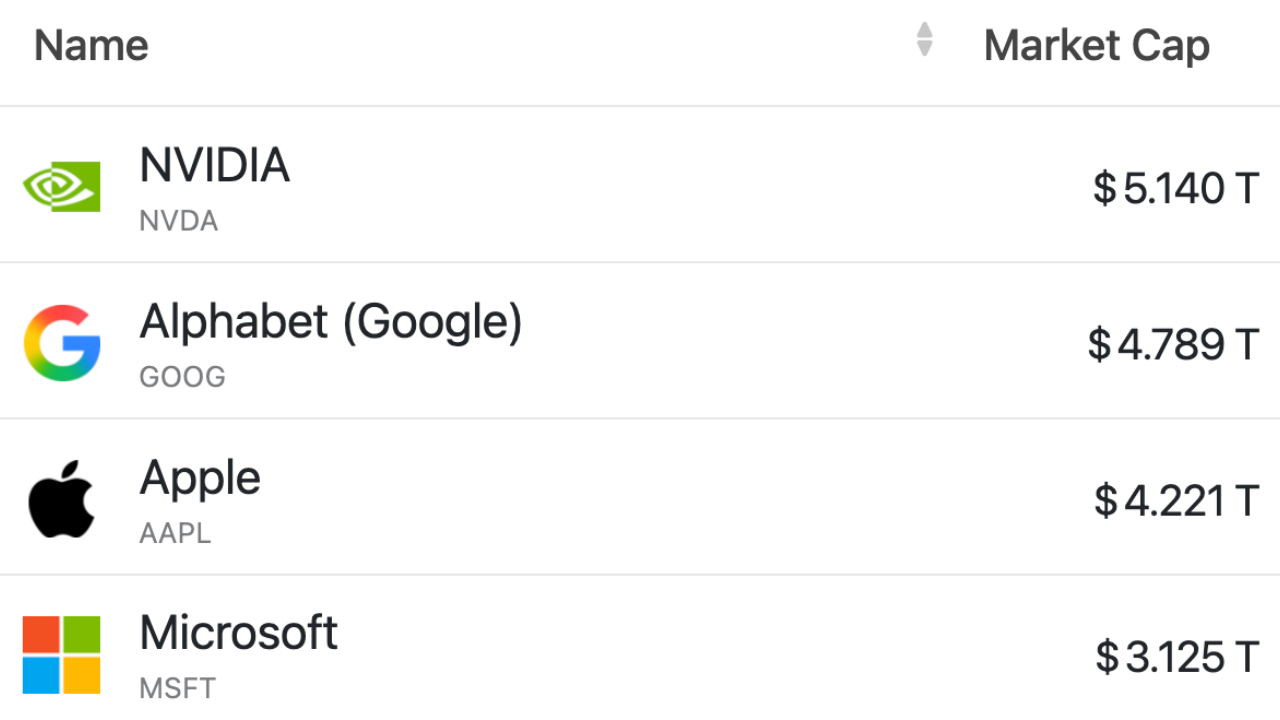
A company's market capitalisation, often shortened to market cap, is the total value of all its shares added together. If you take the share price and multiply it by the number of shares the company has issued, that is its market cap. It is the simplest way to measure how big a public company is.
Twenty years ago, in 2006, the most valuable company in the world was ExxonMobil, the American oil giant, worth around $450 billion. The top of the list was dominated by oil firms, banks, and General Electric. At the time, no public company had ever been worth $1 trillion. Apple eventually became the first US company to cross that line in 2018, and it felt like a huge moment.
Fast forward to today and the picture looks completely different. There are now twelve companies worth more than $1 trillion. Nvidia, the chip maker behind much of the artificial intelligence boom, sits at the top at almost $5 trillion. Alphabet, the parent of Google, and Apple are both around $4 trillion, with Microsoft and Amazon not far behind. Most of the top names today did not even feature near the top twenty years ago.
A common worry for newer investors is missing out on the next big winner, or holding shares in a company that turns out to be in decline. This is one of the reasons we lean towards low cost fund investing as part of the Nisba 6 step framework. A fund holds a basket of companies in one investment, usually weighted by their size. So as a company grows, the fund holds more of it. As another shrinks, the fund holds less. You do not need to predict which business will become the next Nvidia, because if one does, your fund will already own it.
Learn more about Halal Investing
Stay up to date with halal investing
Join our mailing list for the latest insights, updates, and opportunities from Nisba.
We respect your privacy, no spam, ever.